Meta Muse vs ChatGPT: Which AI Assistant Is Better in 2026?
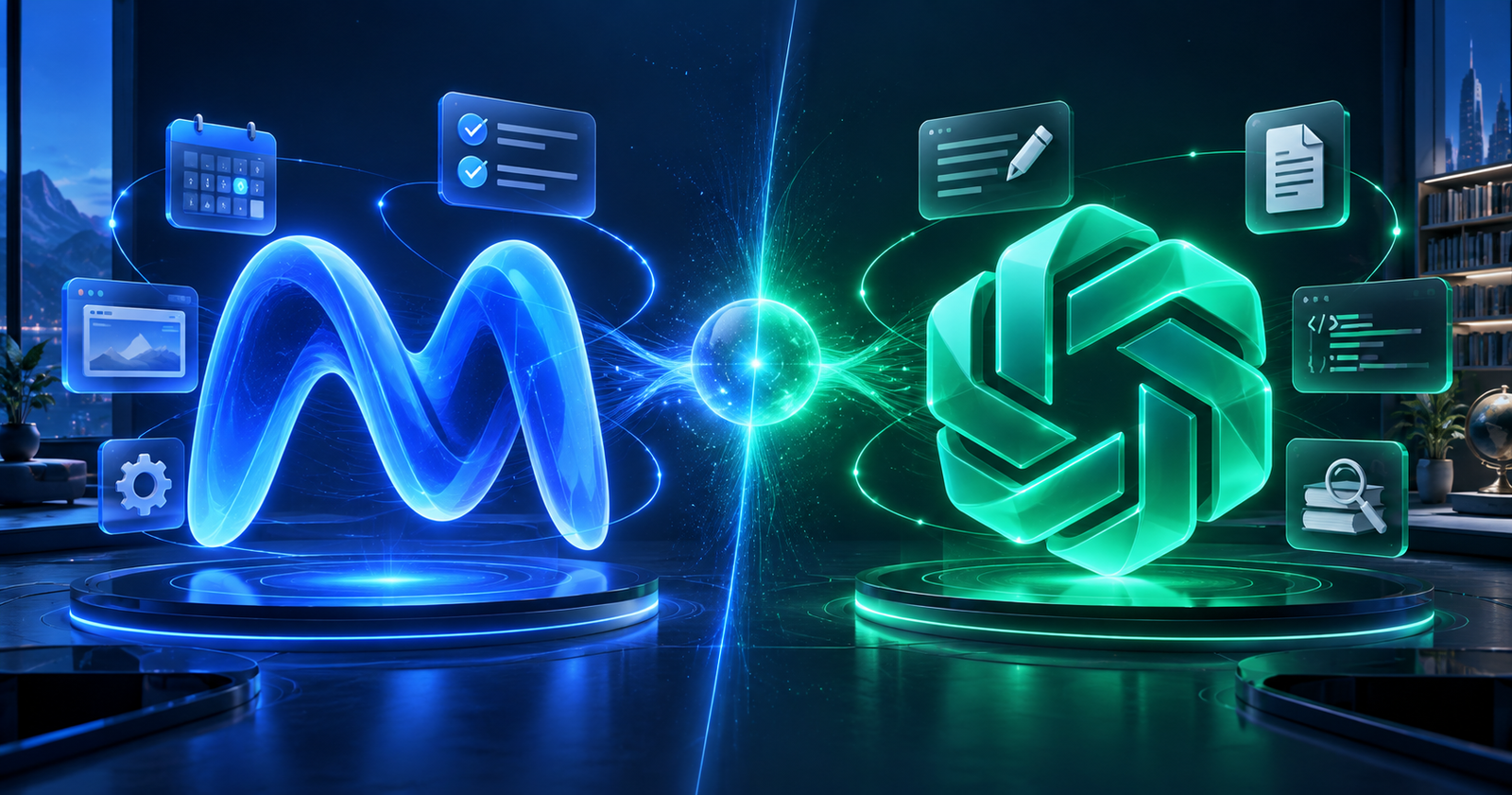
ChatGPT is the better all-purpose AI assistant for most people, while Meta Muse is the better fit for users who want a proactive personal agent to carry out tasks across connected services. This comparison explains where each product wins—and where the choice depends on your workflow.
Meta Muse vs ChatGPT: Quick Verdict
Choose ChatGPT if you primarily need help with writing, coding, studying, brainstorming, web research, file analysis, presentations, or repeatable professional workflows. Choose Meta Muse if you want an agent that learns your preferences, works across connected apps, continues tasks after you leave, and asks for approval before taking sensitive actions.
There is no universal winner. ChatGPT is the more mature general-purpose workspace. Muse is designed more explicitly as a personal agent that can move from conversation to action.
| Category | Meta Muse | ChatGPT |
|---|---|---|
| Best overall use | Delegated personal tasks | General knowledge and professional work |
| Core model | Muse Spark | OpenAI model family, plan-dependent |
| Agent behavior | Proactive, persistent, background execution | Interactive, steerable agent and workspace workflows |
| Strongest ecosystem | Meta apps, WhatsApp, connected personal services | Web, files, plugins, connected work apps, custom workflows |
| Writing and coding | Capable, but not its only focus | Broader and more established workflow |
| Availability | Initial US rollout on web, iOS, and Android | Broad web, iOS, and Android availability |
| Best choice for | Personal coordination and follow-through | Creators, students, developers, researchers, and teams |
What Is Meta Muse?
Muse is Meta's personal AI agent, introduced on September 8, 2026. It is powered by Muse Spark and is designed to do more than answer questions. Meta says Muse can build plans, use a browser, fill forms, coordinate connected services, continue longer jobs in the background, and return when it needs a decision.
Its defining feature is a dedicated environment called Muse Secure VM. According to Meta, each user's agent operates in a contained virtual machine with a separate Sentinel system that reviews outbound actions. Users choose which services Muse can access, and Muse requests approval before sensitive steps such as sending an email or completing a purchase.
Muse launched in the United States on iOS, Android, and the web at muse.ai, with WhatsApp access and future AI-glasses support forming part of Meta's broader direction. Meta says the service is free for most everyday needs, with subscriptions for expanded use.
What Is ChatGPT in 2026?
ChatGPT is OpenAI's general-purpose conversational AI workspace. It supports everyday questions, writing, learning, planning, mathematics, coding, image and file analysis, web research, and tool-assisted work. It is available on the web and through iOS and Android apps.
ChatGPT also offers agentic capabilities. ChatGPT agent can use a visual browser, text browser, terminal, direct tools, and connected apps. The experience is designed to remain interactive: users can interrupt, steer, or take over browser steps while a task is running. ChatGPT also supports memory controls, Temporary Chat, recurring tasks, projects, and specialized workflows depending on the account and plan.
That breadth is ChatGPT's main advantage. It can function as a quick chatbot, a research assistant, a coding partner, a document analyst, or a structured work environment without forcing every request into an autonomous-agent workflow.
Agentic Tasks: Muse Wins for Personal Delegation
Muse has the clearer positioning when the goal is: “Handle this for me and keep working until it is done.” Meta describes examples such as booking travel, negotiating a bill, maintaining a training plan, managing shopping tasks, and coordinating calendars or email.
ChatGPT agent can also research and act across websites and connected apps. Its advantage is control during the process: you can redirect the task, add context, pause it, or take over. Muse's advantage is persistence and personal context. It is meant to remember ongoing goals and make relevant suggestions without requiring a fresh prompt every time.
Winner for delegated personal administration: Meta Muse.
Winner for supervised, flexible agent workflows: ChatGPT.
Writing, Coding, and Research: ChatGPT Has the Edge
For producing and refining content, ChatGPT remains the safer default. Its workflow spans short answers, long-form drafting, structured analysis, file uploads, coding, data work, web research, and presentation-style outputs. OpenAI positions ChatGPT Chat for quick conversational work and ChatGPT Work for larger, reviewable deliverables.
Muse Spark is a natively multimodal reasoning model with tool use, visual reasoning, and multi-agent orchestration. Those capabilities make it technically broad, but the Muse product is optimized around personal assistance and task completion. It is newer, and its strongest differentiator is not simply generating another draft—it is coordinating what happens next.
Winner for writing, coding, studying, and research: ChatGPT.
Integrations and Ecosystem
Meta Muse
Muse benefits from Meta's consumer ecosystem. Muse Spark is also used across Meta AI experiences, with integrations extending through WhatsApp, Instagram, Facebook, Messenger, Threads, and Meta's glasses strategy. This makes Muse compelling for people whose daily communication and discovery already happen inside Meta products.
ChatGPT
ChatGPT is stronger as a cross-platform work hub. Its connected-app ecosystem supports finding and using information from external services, while agent mode can combine web interaction, research, code execution, and authenticated services in one workflow. This is generally a better fit for mixed personal and professional work.
Winner for Meta-native personal context: Muse.
Winner for broad work-tool flexibility: ChatGPT.
Privacy and Control
Both companies emphasize user controls, but their approaches differ.
- Muse: Meta says the agent runs in a dedicated Secure VM, uses a separate Sentinel layer, stores credentials so Muse cannot directly see them, provides an audit trail, requests permission for sensitive actions, and lets users disconnect apps or tell Muse to forget information.
- ChatGPT: Users can manage saved memories and chat-history references, turn memory off, delete remembered information, or use Temporary Chat. Agent workflows can request user intervention for logins and sensitive steps.
These are vendor-described safeguards, not a guarantee that either product is appropriate for every sensitive task. Review current privacy policies, workplace rules, and regional availability before connecting financial, health, or confidential business data.
Pricing and Availability
Meta says Muse is free for most everyday needs, with subscription plans for users who want more. At launch, Muse was rolling out in the US on iOS, Android, and muse.ai. Access can therefore be a deciding factor for users outside the initial market.
ChatGPT has broader global availability and multiple tiers. In the United States, OpenAI announced ChatGPT Go at $8 per month, Plus at $20, and Pro at $200, alongside a free plan; prices and features can vary by country and change over time.
Winner for immediate broad availability and clearly documented plan choices: ChatGPT.
Which AI Assistant Should You Choose?
Choose Meta Muse if you:
- Want an assistant that proactively follows up on personal goals.
- Need longer tasks to continue after you close the app.
- Use WhatsApp and Meta services as the center of your daily communication.
- Prefer delegating multi-step personal tasks over supervising every step.
Choose ChatGPT if you:
- Need one assistant for writing, coding, studying, research, and files.
- Want broader availability and more established plan options.
- Prefer to steer agent tasks interactively.
- Use a mixture of professional tools rather than primarily Meta apps.
Final answer
ChatGPT is better for most users in 2026 because it covers more general-purpose and professional workflows. Meta Muse is better for a narrower but important use case: a persistent personal agent that can coordinate real-world tasks and connected services on your behalf.
Frequently Asked Questions
Is Meta Muse better than ChatGPT?
Muse is better for proactive personal delegation. ChatGPT is better for general writing, coding, research, learning, and professional workflows. Your primary task should determine the choice.
What model powers Meta Muse?
Meta Muse is powered by Muse Spark, a multimodal reasoning model developed by Meta Superintelligence Labs.
Can Muse act without keeping the app open?
Yes. Meta says Muse can continue longer tasks after the user closes the app and return when progress changes or approval is required.
Is Muse available worldwide?
No. Muse began with a US rollout on iOS, Android, and the web. Check Meta's current availability information before relying on it.
Sources and Methodology
This comparison uses product information available on September 20, 2026. Features and prices change quickly. We prioritized first-party documentation and avoided declaring a benchmark winner where the companies did not publish directly comparable tests.
Create a Muse or ChatGPT Screenshot
Build a clearly fictional conversation mockup, customize the appearance, and export it as a portrait or 16:9 PNG.
Create an AI Chat Mockup